
How To Solve Sudoku
This guide shows you how to solve sudoku puzzles in three steps.
Sudoku puzzles can look intimidating and difficult, but with a proper strategy focused on elimination, you can finish a sudoku puzzle in mere minutes.
Step 1: Use the nine big squares
The first step is to assign numbers to cells using the 9 big squares. Every number from 1 to 9 must appear once in every big square. There is no real "proper" place to start a sudoku puzzle; it is up to you. Personally, I like to begin with the centre row. Consider the centre row of the following puzzle (rated medium):
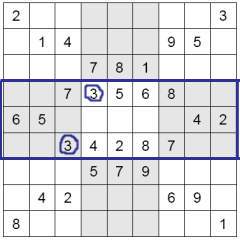 There are two threes in the first two squares, but no three in the last square. On closer inspection, since the two 3s are in two different rows, only the empty box in the middle row is left for the final 3. If the 3 is placed in any of the other empty cells, one of the rows ends up with two 3s. Once you have started, a large chain reaction often follows. With this method you can often solve at least ¼ of a puzzle in this one step! It's also quite common to find all nine of one number in this step alone. Use this method to complete every cell you can.
(In the following diagrams, numbers found with this method are coloured blue.)
Step 2: Fill in each square
The next step is to look at each of the nine individual squares and find as many numbers as possible, knowing that every number from 1 to 9 can appear only once in every square. After step one, you should have at least one or two squares with only a couple of empty cells left (perhaps two or three). It is well worth checking whether some, or even all, of these squares can be filled in. I find it easiest to begin with the box that has the fewest empty cells. In our example, after step one, the leftmost square of the middle row contains these numbers:
4, 2, 7,
6, 5, 8,
3
Only two cells in this square have no number yet. The missing numbers are 1 and 9, so one of the two cells will contain the 1 and the other the 9.
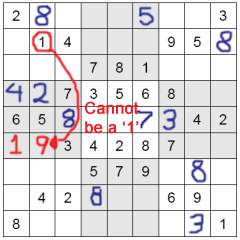 Now to work out which number goes where. Both empty cells are in the same row, so the numbers in the row don't help. Instead, we look at the columns each cell sits in. The column of the first empty cell contains only a 2, a 4, a 6 and an 8. That doesn't help, as we need either a 1 or a 9. The column of the second cell, however, contains an 8, a 1, a 2, a 5 and a 4. Since there is already a 1 in this column, the empty cell can't contain a 1, as that would put two 1s in one column. So the 9 must go in that cell, and the 1 goes in the cell next to it. That square is now solved! The diagram shows the method used to solve this square.
Continue with this method until you have added as many numbers as you can. This step is extremely useful and, like the previous step, starts a chain reaction. Use the numbers you have just solved to keep going. Once this step is done, most of the puzzle should be finished. In fact, if you are lucky and have a good eye, some puzzles can be finished at the end of this step. In the following diagrams, numbers found with this method are coloured red.
Step 3: Finish rows and columns
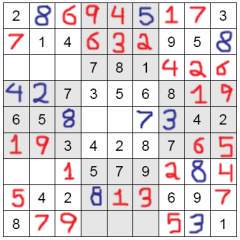 The final step is by far the easiest, as there should now be almost nothing left to complete. The example puzzle could have been completed in step 2, but I deliberately left some cells blank to demonstrate step 3. Here is how our puzzle looks.
As you can see, it is nearly complete. We now finish the puzzle by filling in the individual rows and columns. Every number from 1 to 9 must appear once in each row and column, so we solve the rest by elimination. Take the column furthest to the left. Two cells remain, and the numbers 3 and 9 must go in them. The row of the bottom cell already contains a 9, so the 3 goes in the bottom cell and the 9 in the top cell. Now we have solved a column!
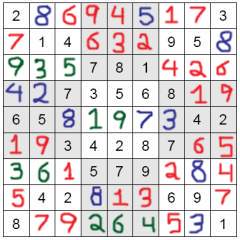 Use this method to complete the puzzle. When you are finished, you should have something that looks like this.
Congratulations, you have successfully solved a sudoku puzzle!
Are you a webmaster?
You can get our sudoku puzzles on your website » Get the Free Sudoku Script here!